Friday, 3 June 2011

DesignLine - could staff still save it?

DesignLine staff were back at work yesterday presumably building buses with less focus than they would normally have as they speculated on their futures.


I can only imagine that the chat would have been over potential buyers, redundancy options, how they'd be entering a job market already flooded by people after the earthquake, and how their lucky break to still be in work after what had happened in the city had finally run out.

They were a well-established manufacturer in Rolleston. Listening to the locals canvassed on radio the other day they sounded genuinely surprised at the situation.

I started thinking about the possibility of local communities buying into companies that should work on the face of it, but have gone bust.

The first example that came to my mind were the various supporter-owned football clubs in the UK's lower leagues, the most well known being AFC Wimbledon. I follow a little, formerly supporter-owned football team in the UK and it's not an uncommon model in other codes with many AFL teams being supporter-owned.

I guess it's reasonable to expect a groundswell of support from a community to financially back their local sporting club. Sport is so closely linked with community pride and the business plan is built on engaging and entertaining their supporter base so locals reach into their pockets.

Whether this holds for communities supporting manufacturing businesses they care about, but don't have such a close interaction with is another matter; especially given the post-'quake economic conditions facing people in Christchurch.

Examples of staff buying out businesses are common. Many businesses even encourage a degree of staff ownership with share offers. A bank my partner worked for rewarded staff with shares no doubt to give employees a greater stake and interest in driving the performance of the bank.

I wonder if any of those conversations around the shop floor yesterday were about the possibility of taking control over their own destiny by pooling their resources and putting in an offer to buy the company.

If they could pull it off they'd have more collective drive to get DesignLine performing again. No doubt they could also unburden the company from it's debt laden owners in the US.

My brother-in-law's a banker and was interested in community micro-finance initiatives while working in Melbourne. I started thinking about how his experience may apply to my speculation about those DesignLine staff and got on to a couple of good Australian sites on how staff and communities can buy into their own futures: Social Traders and the Australian Employee Buyout Centre.

Tuesday, 31 May 2011

A vision to see our country fly

I was lucky to see Sir Paul Callaghan share his aspirations for our country last week.

He's a very thoughtful and convincing man and his vision was described as 'seductive' by someone I spoke with afterwards. I had to agree.

What I liked about Sir Paul was his plan to get this little country's economy performing to our social and environmental expectations.

The crux of his plan lies in shifting our effort into industries which can trade our intellectual capital on the global market.

We are a nation of clever people and we should make the most of it from our own shores and not let our brightest slip away. When he put up the OECD stats on how well our education system performs I was surprised that we rank so highly.

Other surprising realities for me were our current focus on tourism (and to a lesser extent our niche viticulture industry) not measuring up when it comes to the productivity of our country. They just don't bring in enough revenue to the country per person employed in these sectors to make us a wealthier and more liveable nation. He argued that if we continue to focus on tourism we'd become poorer (because we'd have more people working in low-wage jobs) and we'd be overrun by tourists at the expense of our environment.

Where the dairy sector does perform well on this productivity measure (around 3x better than tourism); the country is still working to find the right balance between it's economic contribution and environmental footprint.

I guess for him agriculture can only ever take NZ so far economically before the environmental trade-off is too great; and if we're to do better for ourselves we've got to find other random niches where we can trade on a resource that pays well and one that's not limited by our land - our brains.

Sir Paul's alternative is to give the entrepreneurs, the scientists and the 'crazies' a fair crack at diversifying our economy and finding those global niches. Investment in wide-ranging science and technology programmes from government is something we desperately need to give his vision a kick-start.

For me he struck a perfect balance between a society's needs for environmental, social and economic sustainability. He has undoubted vision, a thoughtful plan to get there and charisma to boot. I was enchanted and convinced.

He tells it better than I do so watch his theory here:

Friday, 28 January 2011

An amusing joke

Two climbers were climbing roped together in the Scottish Highlands. They saw some eagles soaring above them. Later the climbers slipped over the edge of a precipice and unfortunately plunged to their deaths. Their souls left their mortal bodies and ascended to heaven. As they rose they saw the same eagles and one soul cried out to them, 'Ah - Eagles'. But the eagles, being polite, decided to say nothing.

Sunday, 3 October 2010

Veally good

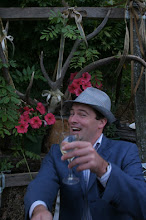
The smile says it all really. Veal. Succulent, melt in your mouth goodness.


In many countries veal is a luxury item. Dishes like blanquette de veau, tournedos de veau and escalopes viennoises are iconic. Which is why I was very surprised to find boned-out veal leg roasts at under $10 NZD a kilo. That's $2 a kilo cheaper than prime beef mince. It's unbelievable value for such a delicacy. So since coming across this find I've treated my family to two braised veal dinners and I have a third stockpiled in the freezer.

Now I've dipped into my Larousse and know he notes that 'the battery-raising of calves is a practice of debatable ethics', but I also know that in New Zealand there's a seasonal supply of dairy beef calves that go into making great young veal. Thankfully here there's no battery-raising required to get this tender, juicy meat.

Even if we weren't so lucky I don't think I'd stop eating veal; as Anthony Bourdain notes in his Les Halles cookbook: 'if I tasted that good after being locked up and immobolized in a dark shed, I wouldn't blame anyone for trying'.

That's because it's that damned good and it's a cinch to cook.

So if you're looking to establish yourself as a credentialed meat-eater then veal should certainly be on your menu.

I flicked through a few of my cook books looking for a recipe and then compared recipes with what I had in the garden, fridge and pantry and came up with this recipe below. It's a lovely and light meal. What's more, the leftover meat is fantastic either thinly cut between bread, or shredded into a tureen dish with the leftover braising liquid and left to set in the fridge.

Take one boned leg roast (1kg+)and seal it by frying in a pan. Let it get nice and golden all round.

While the roast is browning off, get out a casserole dish.
Put 3-4 crushed garlic cloves, a handful of flat-leaf parsley, and some carrots into the dish.

Take the sealed veal and put it into the casserole dish. Pour the oil from in the pan over the meat.

Get a nice big glass of white wine - I've used both a Chardonnay and a dry Gewürztraminer - and pour it over the roast. This is going to be your braising liquid. Season it all well with salt and pepper, put the lid on, put the roast into a hot oven (around 220 degrees in my current antique, which equates to around 180 in my last fan oven) and you're away.

Drop the heat back after 15 minutes and cook it for another hour.

After resting you'll have a roast that'll fall apart on the knife and you'll have to hold back the crew from tucking in before it even hits their plates.

Bon Appetite


Monday, 1 June 2009

Some interesting research about happiness

I just heard an excellent interview with a guy called Joshua Shenk on Radio NZ about a Harvard university study which has been running for 72 years (so you've probably heard about it). I'd heard about it some years ago, initially in a lecture about public health policy, but it seemed timely given my previous entry.

The study takes in the lives of 237 Harvard lads and it makes interesting reading.

Here you go

http://www.theatlantic.com/doc/200906/happiness


http://www.news.harvard.edu/gazette/2001/06.07/01-happywell.html

Thursday, 28 May 2009

Tuesday, 26 May 2009

An unlikely source of inspiration

It only took 90 minutes to turn my month around today.

I've been wading through the vertical filing system that has taken over my desk these past few months in order to get any work done. I've been generating demand which I'm battling to keep up with and I've been snowed under with paper as I move from one task and one meeting to the next. As a result satisfaction levels have been on the wane somewhat and I've been waiting for the dust to settle so I can regroup and de-clutter my desk and mind. 

The dust didn't settle today and the piles of paper are perhaps even less orderly when I left for home than they were at the start of the day, but I've received a boost of inspiration of the kind I've not felt for a long time.

This lift in my general spirits came from a most unexpected quarter: a chat about depression and suicide with three middle aged blokes.

Now before readers start to worry about my state of mind and call my better half to enquire about my mental health I reassure you I am in excellent health and my attendance at this coffee group was out of concern for farmers who are headed into a tough winter. I wanted to get a better feel for the economic climate they'd be facing as well as their seasonal concerns so I could help to put an ambulance at the top of the cliff.

So how on earth do you draw inspiration from a conversation about depression and suicide, surely the coffee wasn't that good?

There's a lot of power in people's personal stories. I've interviewed a few people over the years and have come away with a variety of feelings. I've felt quietly reassured; pumped-up and excited. I've felt respect and admiration, and envy at times.

But I've never felt quite as honoured and as special as I did today. 

I'm not going to do justice to this story. The power of it came through being there and looking into the eyes of a dead man as he told his story. Those eyes positively glowed with reassurance and life.

But here goes.

There were four of us braving the Autumn chill over coffee. One of the four was a dairy farmer. 

Our farmer has been through some tough times in the past few years. Finances and expectations of success have weighed heavily on his shoulders. He has a deep concern for the health and welfare of his cows, which caused many sleepless nights during last season's drought. And he has felt increasingly isolated from his community. This took a toll on his relationships with his family. He said he looks at himself and he knows that he has physically aged through all of this stress.

He lost sleep, fell into depression and contemplated putting an end to it all. 

The way this man opened up to me, a complete stranger, was incredibly brave. 

He walked through the process of gradual decline. He said it was like his world went grey and the front of his brain was cold and shut down. Decision making went out the window. He didn't want to interract with others and he retreated into himself. His mind was constantly replaying the scenarios which related to the causes of his stress - his relationships with his family and concern for his cows, his finances, the weight of expectation and through all this he couldn't find an off switch to get to sleep. 

He wore himself down until he hit rock bottom and spoke to his mates, saw a doctor and a counsellor, and with advice, medication and sleep he got himself back on track.

It was an honour to hear from him what at the time would have been a most intensely private thought process. It was testiment of his strength of character now that he had no trouble sharing this with a complete stranger.  

He is the most inspirational person I have met in months. After 90 minutes the piles of paper seemed inconsequential and I'm brimming with determination to clear them as I get that ambulance to the top of the cliff over the next few months. 

So if you stumble across this blog entry and you're thinking so what's in it for me? What should I look out for? What do I do if my mate, or my partner is in this situation? Here are a few insights from a dairy farmer, a genuine Kiwi who can fly.

  • Going from a place where you're living with stress, to a stage where you're depressed, to the point where you want to end your life is generally a gradual one. It may be hard for your partner to see that you have dropped so low. You may just be that 'grumpy bastard'. It may take someone who'se further removed to pick it. So don't let your mates become isolated so that they have no one outside their immediate family to turn to.

  • If you know you have issues with depression get to know your triggers so you can spot when you're going down hill early on in the piece when you can still make decisions and you can still ask for help. 

  • Take a break from the source of stress and do something for you. Invite yourself around to dinner with friends and neighbours and reconnected with them. Our farmer did it and he said it felt like a holiday. He was put in a situation where he had to be social and he enjoyed the stimulation of conversation and others. 

  • Seek professional advice and make sure that if you're booking an appointment with your doctor make sure it is booked for more than the standard 15 minutes. 

  • If you know someone who's under pressure and is backing away from it all keep in regular contact with them. Make the effort to help them work through the sources of their stress. And let them know that they are not alone and they have support when they are faced with a crisis.

  • And most importantly look after yourself and get your sleep now. You need it to function. It is the best form of prevention. With it you can make better decisions which get you through times of pressure.